CHAPTER II
PRANAYAMA AND ITS PARALLEL IN SPEECH, MANTRAYOGA
THE connection between breath and mind will be fully discussed in speaking of the Magick Sword, but it may be useful to premise a few details of a practical character. You may consult various Hindu manuals, and the writing of Kwang Tze, for various notable theories as to method and result.
But in this skeptical system one had better content oneself with statements which are not worth the trouble of doubting.
The ultimate idea of meditation being to still the mind, it may be considered a useful preliminary to still consciousness of all the functions of the body. This has been dealt with in the chapter on Asana. One may, however, mention that some Yogis carry it to the point of trying to stop the beating of the heart. Whether this be desirable or no it would be useless to the beginner, so he will endeavor to make the breathing very slow and very regular. The rules for this practice are given in Liber CCVI.
The best way to time the breathing, once some little skill has been acquired, with a watch to bear witness, is by the use of a mantra. The mantra acts on the thoughts very much as Pranayama does upon the breath. The thought is bound down to a recurring cycle; any intruding thoughts are thrown off by the mantra, just as pieces of putty would be from a flywheel; and the swifter the wheel the more difficult would it be for anything to stick.
This is the proper way to practice a mantra. Utter it as loudly and slowly as possible ten times, then not quite so loudly and a very little faster ten times more. Continue this process until there is nothing but a rapid movement of the lips; this movement should be continued with increased velocity and diminishing intensity until the mental muttering completely absorbs the physical. The student is by this time absolutely still, with the mantra racing in his brain; he should, however, continue to speed it up until he reaches his limit, at which he should continue for as long as possible, and then cease the practice by reversing the process above described.
Any sentence may be used as a mantra, and possibly the Hindus are correct in thinking that there is a particular sentence best suited to any particular man. Some men might find the liquid mantras of the Quran slide too easily, so that it would be possible to continue another train of thought without disturbing the mantra; one is supposed while saying the mantra to meditate upon its meaning. This suggests that the student might construct for himself a mantra which should represent the Universe in sound, as the pantacle1 should do in form. Occasionally a mantra may be “given,” “i.e.,” heard in some unexplained manner during a meditation. One man, for example, used the words: “And strive to see in everything the will of God;” to another, while engaged in killing thoughts, came the words “and push it down,” apparently referring to the action of the inhibitory centers which he was using. By keeping on with this he got his “result.”
The ideal mantra should be rhythmical, one might even say musical; but there should be sufficient emphasis on some syllable to assist the faculty of attention. The best mantras are of medium length, so far as the beginner is concerned. If the mantra is too long, one is apt to forget it, unless one practices very hard for a great length of time. On the other hand, mantras of a single syllable, such as “Aum2” are rather jerky; the rhythmical idea is lost. Here are a few useful mantras:
- Aum.
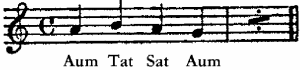
- Aum Tat Sat Aum. This mantra is purely spondaic.
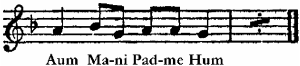
- Aum mani padme hum; two trochees between two caesuras.
- Aum shivaya vashi; three trochees. Note that “shi” means rest, the absolute or male aspect of the Deity; “va” is energy, the manifested or female side of the Deity. This Mantra therefore expresses the whole course of the Universe, from Zero through the finite back to Zero.

- Allah. The syllables of this are accented equally, with a certain pause between them; and are usually combined by fakirs with a rhythmical motion of the body to and fro.
- Hua allahu alazi lailaha illa Hua.
Here are some longer ones:
- The famous Gayatri.
Aum! tat savitur varenyam
Bhargo devasya dimahi
Dhiyo yo na pratyodayat.Scan this as trochaic tetrameters.
- Qol: Hua Allahu achad; Allahu Assamad; lam yalid walam yulad; walam yakun lahu kufwan achad.
- This mantra is the holiest of all that are or can be. It is from the Stele of Revealing3
A ka dua
Tuf ur biu
Bi aa chefu
Dudu ner af an nuteru.
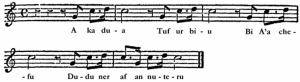
Such are enough for selection4.
There are many other mantras. Sri Sabapaty Swami gives a particular one for each of the Chakras. But let the student select one mantra and master it thoroughly.
You have not even begun to master a mantra until it continues unbroken through sleep. This is much easier than it sounds.
Some schools advocate practicing a mantra with the aid of instrumental music and dancing. Certainly very remarkable effects are obtained in the way of “magic” powers; whether great spiritual results are equally common is a doubtful point. Persons wishing to study them may remember that the Sahara desert is within three days of London; and no doubt the Sidi Aissawa would be glad to accept pupils. This discussion of the parallel science of mantra-yoga has led us far indeed from the subject of Pranayama.
Pranayama is notably useful in quieting the emotions and appetites; and, whether by reason of the mechanical pressure which it asserts, or by the thorough combustion which it assures in the lungs, it seems to be admirable from the standpoint of health. Digestive troubles in particular are very easy to remove in this way. It purifies both the body and the lower functions of the mind5, and should be practiced certainly never less than one hour daily by the serious student.
Four hours is a better period, a golden mean; sixteen hours is too much for most people.
- See Part II
- However, in saying a mantra containing the word “Aum,” one sometimes forgets the other words, and remains concentrated, repeating the “Aum” at intervals; but this is the result of a practice already begun, not the beginning of a practice.
- See Equinox VII
- Meanings of mantras:
- Aum is the sound produced by breathing forcibly from the back of the throat and gradually closing the mouth. The three sounds represent the creative, preservative, and destructive principles. There are many more points about this, enough to fill a volume.
- O that Existent! O! – An aspiration after realty, truth
- O the Jewel in the Lotus! Amen! – Refers to Buddha and Harpocrates; but also the symbolism of the Rosy Cross.
- Gives the cycle of creation. Peace manifesting as Power, Power dissolving in Peace.
- God. It adds to 66, the sum of the first 11 numbers.
- He is God, and there is no other God than He.
- O! let us strictly meditate on the adorable light of that divine Savitri (the interior Sun, etc.). May she enlighten our minds!
- Say:
He is God alone!
God the Eternal!
He begets not and is not begotten!
Nor is there like unto Him any one!
- Unity uttermost showed!
I adore the might of Thy breath,
Supreme and terrible God,
Who makest the Gods and Death
To tremble before Thee: –
I, I adore Thee!
- Emphatically. Emphatically. Emphatically. It is impossible to combine Pranayama properly performed with emotional thought. It should be resorted to immediately, at all times during life, when calm is threatened. On the whole, the ambulatory practices are more generally useful to the health than the sedentary; for in this way walking and fresh air are assured. But some of the sedentary practice should be done, and combined with meditation. Of course when actually “racing” to get results, walking is a distraction.